



In June 2026, we traded our familiar Canadian skies for the wild winds and glowing sands of Tinos, Greece. This trip was meant to be a slow, sensory escape: long breakfasts, cold seas, glowing beaches, and an island that still feels raw and real. We traveled as a family, two adults and one very opinionated toddler, during the second week of June. We had planned to start the journey in the most efficient way possible, with the 7:40 a.m. ferry from Rafina to Tinos. On paper, it was a perfect plan: arrive early, catch the ferry, reach the island with plenty of time to settle in and ease into vacation mode. In reality, traveling with a toddler has its own rhythm. No matter how well you plan, everything simply takes longer than you expect.
We pulled into the port at 7:41 a.m. and watched the ferry we were supposed to be taking already sailing away. We had missed it by a single minute. Instead of letting it set the tone of our vacation, we did what traveling with a child slowly teaches you to do: we adapted. We walked over to the Seajets ticket office and explained what had happened. To our surprise and relief, they changed our tickets to the evening ferry at no extra cost. We suddenly had a free morning and afternoon with no agenda, just time to wander, shop a little, and stretch out the anticipation of actually arriving on Tinos.
First Glimpses of Tinos
By the time we finally boarded the evening ferry, we were a little tired, a little rumpled, and very ready. The ferry, predictably, was late; we arrived on the island about an hour behind schedule. But the moment we stepped off onto Tinos, the delays stopped mattering. We arrived during golden hour, when the light in Greece softens the edges of everything it touches. My first impression of Tinos was that it felt raw and expansive.

The island seemed covered in fields of hay-colored vegetation, stretching across hills and plateaus as far as the eye could see. It was not a smooth or manicured landscape. There were long, parallel formations of earth and stone that cut across the slopes, almost like low embankments or old flood walls, tracing lines around the hills. The effect was both rugged and strangely sculpted, as if time and human effort had tried to tame the land but never fully succeeded. The wind was impossible to ignore. It did not simply breeze by; it blew with presence and insistence, filling our lungs and reminding us at every step that we were standing on an island in the Aegean, exposed to the elements.
Ivy Natural Resort near Arnados Village
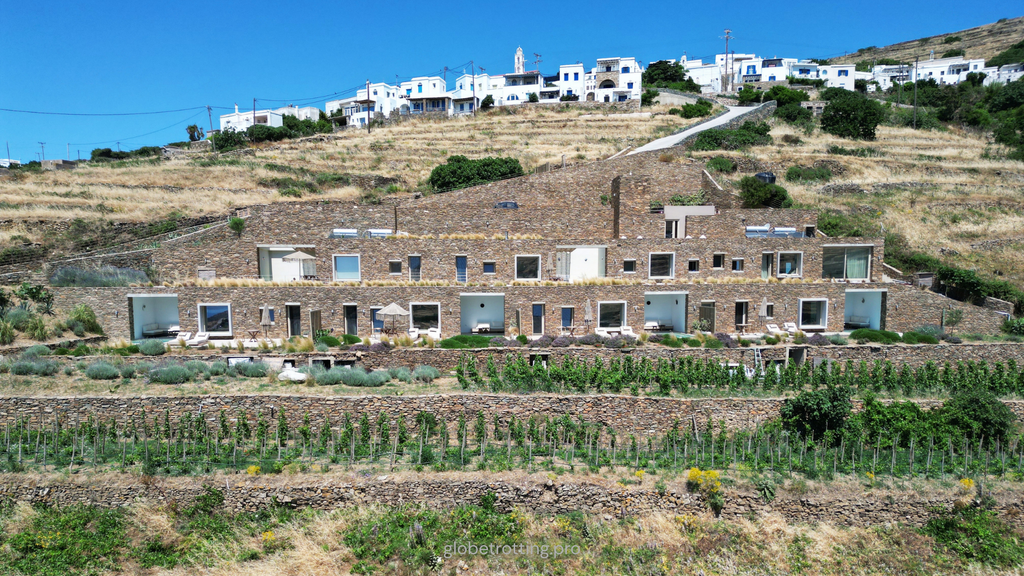
From the port, we drove into the hills toward our hotel, Ivy Natural Resort, in the area of Arnados. This was one of the places we had been most excited about before the trip. The resort felt as though it had been built into the hillside rather than simply placed on top of it. The architecture was minimalistic and contemporary, but it did not feel cold. Instead, it blended into the landscape in a way that made you immediately slow down. At check-in, the hostess greeted us with cherry juice and small desserts from Mesklies bakery, made of almond and cherry. It quickly became one of my favorite flavors of the trip: an almond cookie with a crunchy cherry center, the sweetness and texture combining in a way that felt both comforting and slightly indulgent.

Our room reflected that same philosophy. It was simple and uncluttered, but every detail felt deliberate. The real magic was outside the glass sliding door: a balcony with our own small private pool, sun beds, and an uninterrupted view over the golden fields and the sea beyond. The horizon felt huge. The hay-like terrain rolled outward toward the water, the wind constantly pushing waves of movement through it, as if the land itself was breathing. Standing there, with the wind in our faces and the light softening into evening, I felt that familiar, exhilarating sensation of the first night of a holiday: all your days still ahead of you, untouched and full of possibility.


Marathia Restaurant
We discovered Marathia after seeing its owner and executive chef, Marinos Souranis, on a Greek cooking show. His approach to aging fish was unlike anything we had encountered before. The dry-aging and maturation techniques he used deepened flavors and transformed texture. Since opening in 2002, the restaurant has built close relationships with local fishermen, farmers, and artisans, with a menu that changes seasonally and makes thoughtful use of every part of the fish. Rather than relying on elaborate techniques or presentation, the focus is on letting exceptional ingredients speak for themselves.

We began with their playful take on a Caesar salad, actually named Seasar’s Salad. It arrived at the table crisp and refreshing, filled with light-cured shrimp, tuna bacon, Tinos gruyere cheese, tarama emulsion, pickled foraged greens, and bread croutons. It was familiar enough to be comforting, but with enough twists to keep every bite interesting.
One of the most memorable dishes of the evening was the Pescuto di Tinos: thin slices of skipjack tuna, dry-aged for a full year, served in the style of prosciutto alongside hot sourdough bread and fresh butter. The owner himself brought out the whole fish before cutting into it, presenting it to us at the table. Watching him slice it with practiced precision and then arrange the delicate pieces on a small plate felt almost ceremonial. The flavor was rich and deep, a concentrated expression of the sea.

We also ordered marinated sardines, served warm in vine leaves, and cooled down with tomato sauce, as well as a savory pie made with Tinian Petroma, a local cheese, combined with aged Gruyère and herbs, wrapped in handmade corn phyllo. But the true star of the evening, the dish that we still talk about, was the tuna ribeye. The tuna had been aged for twenty days, so it required only a brief finish over the grill. The team brought a small oven to our table and cooked it right in front of us for just a couple of minutes, barely long enough to seal the exterior while leaving the inside buttery and tender. It was served with grilled and smoked vegetables alongside a rich broth made from its own bones. Our toddler, who is generally cautious and often picky with food, devoured it with absolute enthusiasm. That, for me, was perhaps the most honest review of all. The tuna ribeye was priced at €110 per kilo, but the portions were around two to three hundred grams, making it a splurge that felt entirely justified.

For dessert, we chose two very different creations. The first celebrated seasonal pumpkin, transformed into a complex, contemporary dessert where every bite revealed a different combination of flavours and textures. The second drew inspiration from a much simpler past: bread, olive oil and ice cream, echoing what people might have eaten a century ago in Greece, when sugar and desserts as we know them were far less common. It tasted like memory transformed into something both nostalgic and new. By the end of the meal, we had eaten generously. The total bill for two people, including all these dishes and the setting overlooking the sea and the restaurant’s own beach bar, came to around EUR 160. Considering the quality of the food, the technique, the service, and the overall experience, it felt not just fair, but remarkable.
Slow Mornings at the Hotel
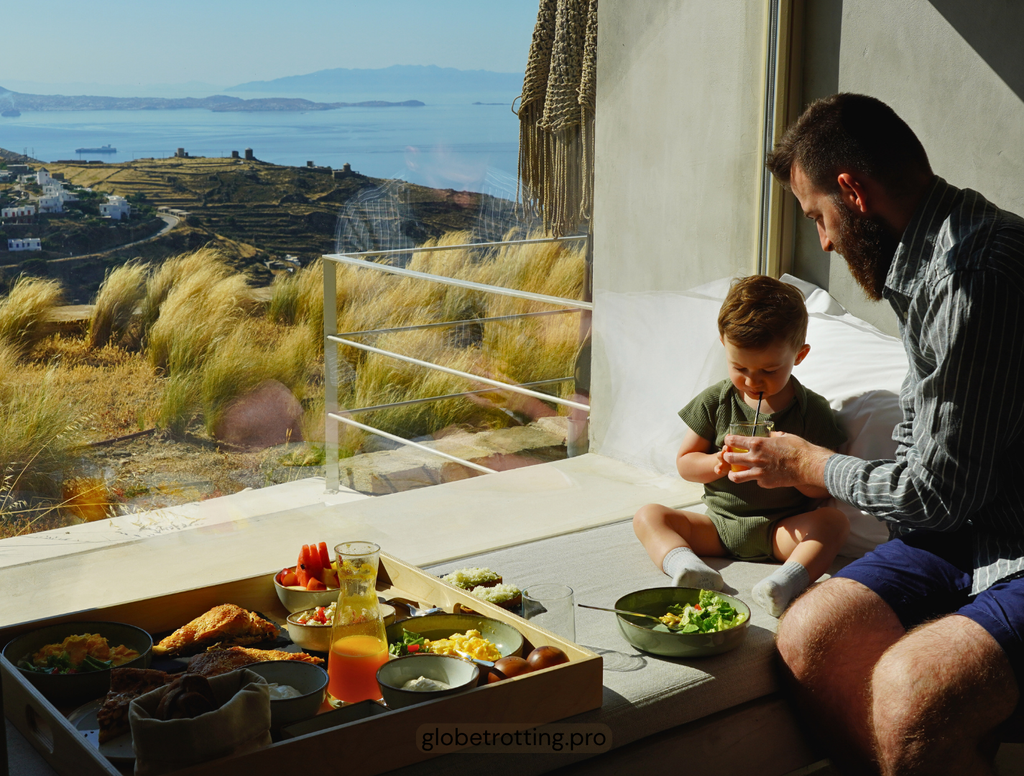
The next morning at Ivy Natural began with light and quiet. Our bed faced a huge square window that looked out over the landscape, almost like a perfectly framed painting. The window had a wide built-in ledge, a kind of daybed where you could sit or lie down and simply watch Tinos wake up. From that spot, we could see the golden-brown fields shifting with the wind, the sea in the distance, and the wide, open sky above it all.

One of the loveliest aspects of staying at Ivy Natural was that breakfast was brought directly to our room every morning. We ordered the night before, and by morning a tray would arrive that turned our balcony into a private café. We found ourselves returning to the same favorites: scrambled eggs, croissants, avocado toast, fresh fruit, their handmade spinach pita served with local cheeses, and freshly squeezed orange juice. And always, freddo espresso, the kind of strong, fragrant coffee that I love most in Greece. We ate slowly by the pool, the air cool and clean on our faces, our toddler alternating between jumping on the bed, exploring the balcony, and attempting to splash in the pool. It was the kind of morning that makes you feel suspended outside of normal time, where nothing is urgent, and everything is quietly pleasurable.
We finally left the hotel around eleven-thirty, not rushed at all, and headed toward the beach of Agios Romanos. On the way, we passed a tiny white church where three horses grazed peacefully on dry hay, a scene that felt as though it belonged to another era. The light was slightly foggy, the air soft, and we stopped to take a picture, wanting to capture something of that raw simplicity. Because it was the beginning of June, we escaped the kind of intense heat that usually defines the Greek summer. For us, coming from Canada, the milder temperatures, combined with the wind, felt both familiar and comfortable.

Lefko Beach Bar at Agios Romanos Beach
For our first full day on the island, we wanted something easy, without too much driving or planning, so we settled on Agios Romanos Beach, named after the Church of Saint Romanos nearby. We made our way to Lefko Beach Bar, which sits right on the water. The beach was relatively quiet, the sunbeds comfortable, and our toddler seemed far more confident this year than he had been the previous summer in Milos, where the sea had appeared to him as a strange, threatening creature.

This time, he ran toward the waves instead of away from them, splashing in the shallow water, laughing, and quickly getting soaked and sandy. One of the gifts of traveling with a toddler is the way their energy comes in intense bursts and then collapses. After a while of play, he fell asleep and napped on the sunbed for two or three hours, leaving me with the rare luxury of uninterrupted reading time. I returned to one of my favorite territories: the classics, this time picking up Dostoevsky’s “Notes from Underground,” sometimes translated as “The Basement,” and letting my mind drift between Russia and the Aegean.

I waited until later in the day to swim, hoping that the water would have warmed up at least a little. It had not. When I finally stepped in, the sea was shockingly cold, a sharp contrast to the softness of the air. I went in bravely and came out almost immediately, laughing at my own optimism. We stayed at the beach until sunset. What stayed with me most vividly from that day, was the sand at the beach. In certain places, it seemed to glow, as if someone had scattered silver dust across it. It caught the light in a way that made portions of the beach shimmer, turning an ordinary stretch of sand into something quietly magical.
Like Salt
That evening, we ate at Like Salt, a taverna whose name plays loosely with the word “salt” and the phrase “I love you like salt,” tying flavor and affection together. One of the first things that charmed me about this place was its menu, which was written like a fairytale. It told a story about a king and his daughters and wove in the idea of loving someone “like salt,” in the sense that salt is essential yet often taken for granted. It was a simple but poetic way of connecting food, love, and everyday life.

The dishes continued that same sense of thoughtful comfort. We ordered zucchini flowers, delicate and full of flavor, and chickpeas baked in the oven with tomato, basil, and mint, softly stewed and aromatic. We had fresh fish served with kritaraki, a small pasta that looks like rice and has the same sort of soothing, familiar texture, and a fish carpaccio, with tomato, onions, and lime, bright and refreshing. A potato salad with capers, almonds, and garlic combined creaminess with crunch and saltiness in a way that felt very much of the island. We rounded out the meal with a plate of fried shrimp, crisp, simple, and perfect for sharing.
Agios Athanasios Church
On our third day, we kept the same slow rhythm. After another unhurried morning at the hotel, we decided to explore the interior of the island and visit one of its most beautiful villages, Pyrgos. The drive there brought its own surprises. Somewhere along the way, we noticed a striking tower-like structure with a cluster of buildings around it that looked like small churches. It stood alone against the landscape in a way that made it impossible to ignore, so we pulled over to see what it was.
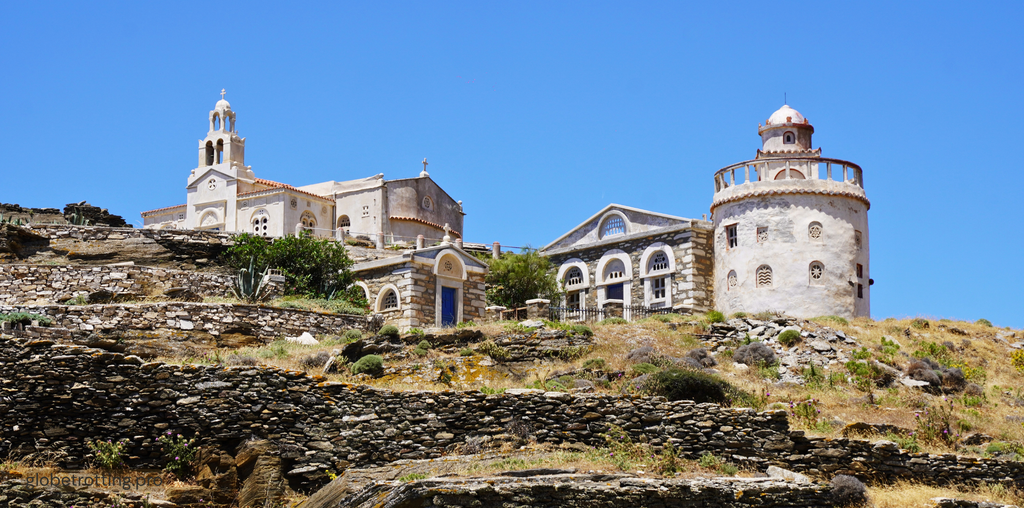
We discovered that it was a church dedicated to Saint Athanasios, which felt especially meaningful because Athanasios is my husband’s name. We climbed the steps to the top of the tower, and from there, the view was astonishing: hills, valleys, and the island stretching outward under a sky that seemed to be forever in motion, the wind stronger than ever. It whipped around us in powerful gusts, almost overwhelming, but at the same time exhilarating.

Outside the church, we came upon something even more unexpected: the tomb of the Archbishop of Greece Hieronymus, who lived from 1905 to 1988. His resting place sits at the edge of the hill with a magnificent view over the landscape, serene and exposed at the same time. It felt both solemn and strangely intimate, as if he had been given the gift of watching over the island even in death.


Village of Pyrgos
After a brief stop at the Church of Agios Athanasios, we made our way to Pyrgos, the largest village on Tinos and the historic heart of Greek marble craftsmanship. Even before you step into the main square, you can feel that this is not just another pretty Cycladic village but a place that carries centuries of artistic tradition. Its name dates back to the 16th century, when the Venetians built a watchtower here for defense, and over time Pyrgos evolved into a true cultural beacon. During the 18th and 19th centuries, it played a pivotal role in the Greek War of Independence and produced some of Greece’s most celebrated modern sculptors and painters, such as Yannoulis Chalepas and Nikolaos Gyzis. Surrounded by deposits of rich white and green marble, the village grew into a premier artistic center where stone is not just a building material but part of the local identity.

We roamed around the village during lunchtime, which meant that everything felt calm and almost suspended in time. This is usually our favourite time to explore Greek islands. Most people have retreated indoors for lunch or a siesta, leaving the lanes to the cats and the occasional passerby. As someone who loves photography, I’ve also come to appreciate the way the strong midday light falls across the whitewashed walls. Just as importantly, there is something wonderfully peaceful about photographing a village without crowds.

At one point, we wandered into the courtyard of the Holy Trinity Church. Scattered across the ground was a pile of bright pink bougainvillea blossoms that had fallen from the vines above. Before long, our toddler and I were scooping them up by the handful and tossing them into the air, laughing as they drifted back down around us like a shower of pink confetti. It became one of those completely unplanned moments that we ended up remembering most.

Afterwards, the midday sun grew too strong, and it became clear that we needed a pause. We gravitated naturally toward the heart of the village, the central square, where everything seems to converge. In the middle of the square stands a huge plane tree that anchors the space, its branches stretching wide and offering deep, welcoming shade. We settled at Platanos Café, which takes its name from this magnificent tree, and it felt like sitting in the living room of the entire village. Around us, several restaurants, cafés and tavernas clustered together, all facing the same square, giving the impression that life in Pyrgos circulates around this one communal point. It was cozy and warm in that uniquely Greek way, with locals and visitors sharing the same space under the same canopy of leaves.

To our right stood a monumental 18th-century fountain carved from local Tinian marble, shaded by the sprawling branches of the centuries-old plane tree. Its surface was covered with delicately carved reliefs of flowers, birds and subtle religious motifs, showcasing the extraordinary craftsmanship for which Pyrgos is known. More than a functional fountain, it felt like a piece of public art. Looking around the square, I noticed the same attention to detail everywhere, in the carved doorframes, lintels, balconies and workshops that lined the streets. In Pyrgos, marble isn’t reserved for monuments or museums. It is simply part of everyday life.

Museum of Marble Crafts in Pyrgos
Because the Museum of the Greek Sculptor, Yannoulis Chalepas, was closed for renovation, we continued our exploration at the Museum of Marble Crafts in Pyrgos. This museum is a state-of-the-art tribute to Tinos’ UNESCO-recognized tradition of marble carving. Inside, you can see original architectural elements such as doorframes, lintels, fountains, coats of arms, and small religious shrines, all created by master carvers from the island. There are displays of historical tools used for cutting and shaping marble, which help you understand just how demanding and precise this craft is. Audiovisual installations and documentary footage bring old workshops back to life, showing artisans at work and explaining how raw stone is transformed into art and architecture.

One of the details that stayed with me was a large sign at the entrance, explaining that the ancient Greeks used the word “marble” for any stone that glistened or shimmered in the sunlight. After spending time in Pyrgos, that description felt absolutely right. The entire village seems to catch the light and reflect it, not just as a physical glow, but as a living testament to centuries of creativity and craftsmanship.

T-OINOS Winery
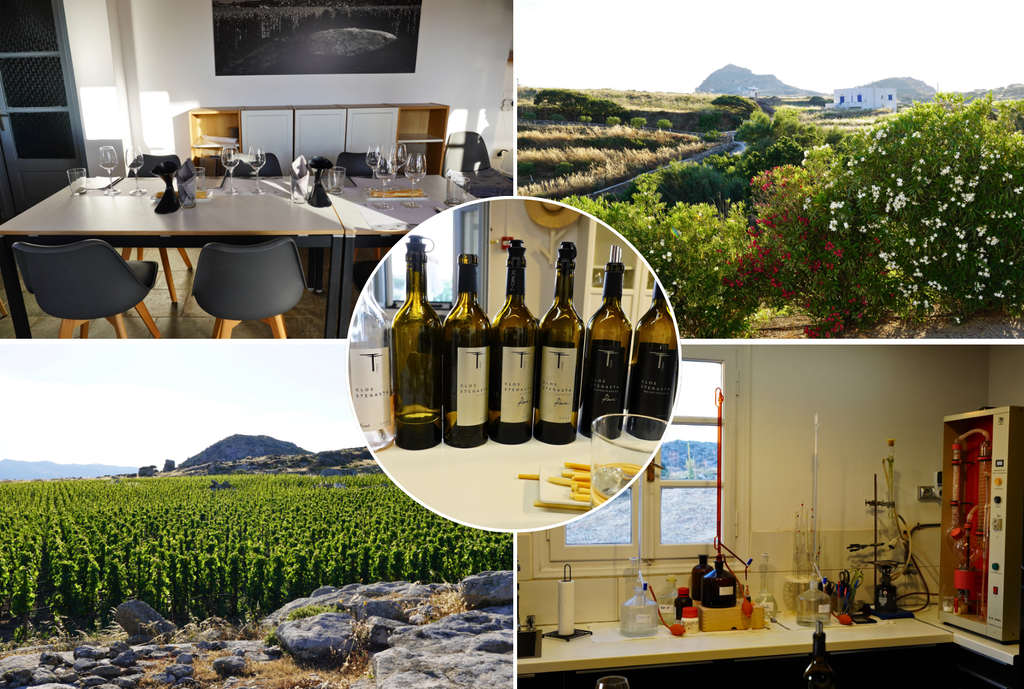
That afternoon, we had booked a wine tasting experience at T-OINOS, one of Tinos’ most renowned wineries. As we drove toward Falatados, the landscape became increasingly dramatic, with enormous rounded granite boulders scattered across the hills as though they had fallen from another planet. Our visit began with a tour of the Clos Stegasta vineyard, although, like many parents traveling with a toddler, I experienced it in fragments while chasing our son between the vines.

At one point, I gave up trying to keep my sandals on as they kept sinking into the soft sandy paths between the vine rows, praying that we wouldn’t encounter any snakes. One story, however, stayed with me. Traditionally, wine in this area was aged in large clay vessels buried in the vineyard itself. Over generations, fragments of clay became part of the soil, subtly influencing the vines, while the finished wine was transported in sheep and goat skins across the island.

The tasting room reflected the winery’s philosophy: understated, modern, and entirely focused on the wine. Unlike the generous food pairings we had enjoyed at wineries in the Peloponnese the previous year, here the only accompaniment was a handful of breadsticks. We tasted the T-OINOS Mavrose 2025, Clos Stegasta Rose 2023, Clos Stegasta Asyrtiko 2024 and Clos Stegasta Asyrtiko Rare 2022 and 2023, Clos Stegasta Mavrotragano 2022, and the Clos Stegasta Mavrotragano Rare 2022, learning how each vintage reflected the year’s weather and growing conditions. The nuances between the wines were subtle enough that they probably required a far more experienced palate than ours to appreciate fully. We eventually brought home a bottle of the Mavrotragano 2023 and the Assyrtiko 2024. Although the Rare was nearly twice the price, we both agreed that the difference wasn’t significant enough for our palates to justify the extra cost.
The tasting itself became memorable for an entirely different reason. A year earlier, our son had happily escorted us through most of our winery visits. This time, he had no interest in sitting still. We took turns entertaining him, wandered outside between pours, and even enlisted Ms. Rachel for a few precious minutes of peace. It was a different kind of wine tasting than we were used to, but one that reflected this stage of our lives. We were especially grateful to the other couple who shared the experience with us. They were incredibly patient and understanding as we took turns chasing after an energetic toddler between pours. As we left, the sun was setting over the vineyard, painting the sky in soft shades of orange and purple. It was the perfect ending to another slow day on Tinos.
Ntouar Tavern
By the time we left the winery, it was getting late, and our hostess suggested a traditional taverna about ten minutes away called Ntouar. The courtyard outside the tavern was full of families and friends lingering over long dinners beneath the trees. The staff happily brought out another table so we could join them outdoors. The tavern began decades ago as a small butcher shop run by Edward (Ntouar) Armakolas before he and his wife, Stamatiki, transformed it into a family restaurant. Today, their children continue the tradition, and it remains one of the island’s best-known destinations for meat.

While our food was being prepared, I wandered into a nearby shop called Ergon Art, expecting to browse for a few minutes and instead lingering much longer. The space felt more like a working studio than a store, filled with handcrafted marble pieces, sculptures, jewelry, and decorative objects inspired by Tinos’ artistic heritage. The owner welcomed me warmly and took the time to explain the stories behind many of the pieces he had created himself, describing the marble, the techniques, and the inspiration behind each design. I left with a few small souvenirs, but more than anything I appreciated meeting someone who so clearly loved what he made.

As I lingered in the shop, my husband and our toddler had already claimed our table, patiently waiting while the first dishes began arriving. We started with a dakos salad, followed by grilled liver and a selection of homemade pies. The food was simple, generous, and exactly what we were craving after an afternoon of wine tasting. Cats wandered quietly through the square between the tables while conversations carried on around us, creating one of those relaxed summer evenings that seem to unfold effortlessly in Greece.

Our son had been so exhausted from a full day of exploring that he fell asleep before the food arrived. I had secretly hoped he would try some of the meat, but instead one of the generous pieces of grilled liver found a different audience. Since my husband doesn’t eat meat, I began sharing it with the cats that quietly wandered through the courtyard. Before long, they had gathered around our table, some far bolder than others. A few confidently claimed the largest pieces, while others lingered cautiously at the edge, including one that appeared to have lost an eye. I found myself trying to distribute the food as fairly as I could, making sure the more timid cats had a chance as well. It’s something I always struggle with when dining outdoors in Greece. I can’t help but notice the stray cats, and I always leave hoping they’ve all had something to eat.
Mikri Kolymbithra Beach
The next day unfolded at the same unhurried pace. We slept in, lingered over breakfast on our balcony, and took advantage of one of the only two windless days during our week on Tinos to fly our drone around the hotel. Watching the island from above gave us a completely different perspective of the dry hills, winding roads and scattered white villages that blended so naturally into the landscape.

We eventually made our way toward Kolymbithra Beach, famous for its retro mushroom-shaped umbrellas and for attracting surfers and windsurfers when the Meltemi winds sweep across the bay. As we drove past Megali Kolymbithra, however, we found ourselves drawn instead to nearby Mikri Ammos. With its emerald-turquoise water, soft sand and more sheltered setting, it immediately felt like the kind of beach where you could happily spend an entire day. We rented a pair of sunbeds and an umbrella for €25 and settled in with no real plans beyond enjoying the sea.

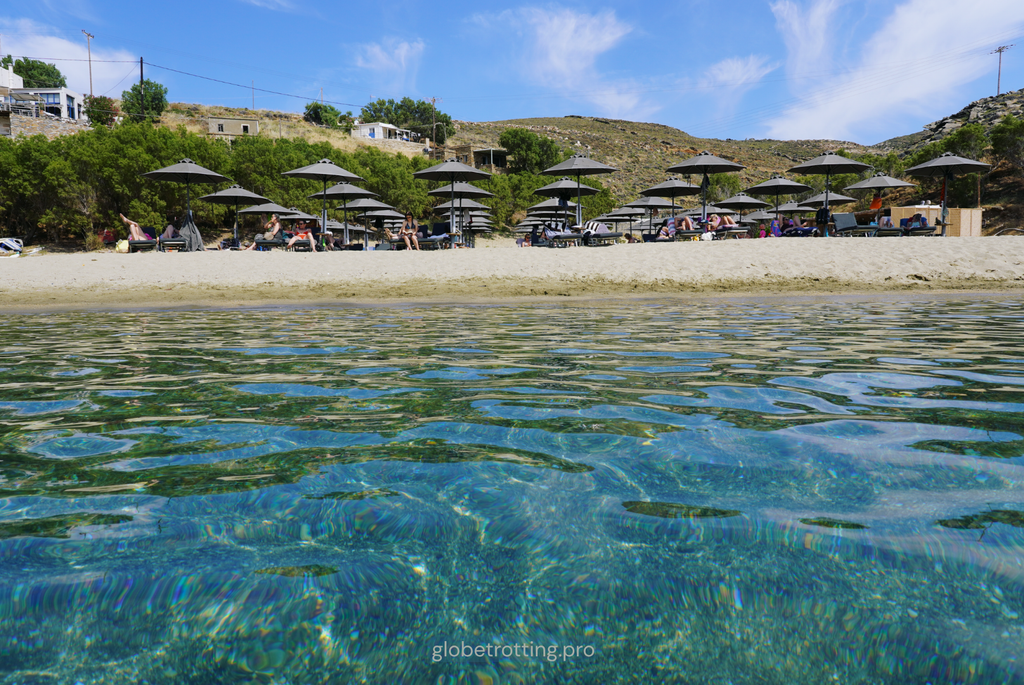
This was our first proper swim of the trip. At Agios Romanos, the water had been so cold that I barely managed a few minutes before retreating to my towel. Here, it was refreshingly cool without being icy, and unlike the shallow beaches that are often recommended for families, the water deepened just enough for the kind of swimming I enjoy. While I happily spent time in the sea, our toddler did what had become his vacation routine. After hours of running, digging and splashing in the sand, he fell into another long afternoon nap, giving us a few quiet hours to read, swim and simply enjoy the rare luxury of having nowhere else to be.

Thalassaki Restaurant
That evening, we drove to Thalassaki in Ysternia, one of the two restaurants that had been on our “must visit” list before arriving on Tinos. While Marathia impressed us with its creativity, Thalassaki won us over with its simplicity and its setting. The restaurant sits quite literally at the edge of the sea, so close to the water that small signs warn diners that on particularly windy days the waves can reach the tables. Friends had told us stories of front-row diners getting splashed when boats passed by, and although the sea was calm that evening, it was easy to imagine. As we settled in, we noticed something familiar. The couple who had shared the wine tasting with us a few days earlier were seated only a few tables away. On an island the size of Tinos, it somehow felt inevitable.

We began with a bottle of Alkar Potamisi 2023 before sharing an artichoke salad, aged Kopanisti cheese served with vanilla-scented pears, and a beautifully steamed fillet of fagri over lemon couscous, which ended up being my favourite dish of the evening. Everything was thoughtfully prepared without feeling overly complicated, allowing the freshness of the ingredients to take centre stage. But the dessert stole the show. We ordered an ice cream flavoured with rose loukoumi, expecting something pleasant and ending up with one of the best ice creams I have ever tasted. Our toddler and I devoured it together, each determined to claim the next spoonful before the other could.

Church of Panagia Evangelistria
The following day, my husband’s sister and cousin joined us on Tinos for a day trip, so we spent the day exploring Chora, the island’s main town. The streets were lively, lined with cafés, shops and whitewashed buildings connected by narrow cobblestone alleys that invited slow wandering. It felt different from the mountain villages we had visited earlier in the week, more vibrant but still unmistakably Cycladic.

Our main destination was the Church of Panagia Evangelistria. From the port, a long carpeted path leads uphill to the church, and along the way we witnessed one of the island’s most moving traditions. Many pilgrims were making the journey on their knees, some fulfilling vows, others expressing gratitude or praying for healing. Seeing parents accompanying children with visible disabilities was particularly emotional. Ever since becoming parents ourselves, scenes like that affect us differently. Throughout our visit, I found myself quietly grateful that we were there simply as visitors, not carrying the weight of the prayers that had brought so many others to this place.

We had arrived during the Saturday service, and the church was overflowing, with people waiting even on the steps outside. Rather than joining the queue, we spent the next couple of hours exploring the peaceful galleries within the church complex, including the art gallery and the Museum of Tinian Artists. I found myself enjoying the quiet cloisters just as much as the exhibits. The wide balconies overlooked the sea, shaded by mature trees that softened the summer light, and the whole complex had the calm atmosphere of a monastery.


We had been advised to return later in the afternoon, so rather than waiting around, we wandered back into Chora and stopped at Agkinara Cafe for coffee and refreshments. It was the perfect excuse to slow down and enjoy the town. We strolled through the narrow cobblestone streets, browsed a few shops and watched our toddler become instant friends with a dog named Milo, dancing around him while everyone nearby smiled at the spectacle.


Drosia Taverna
For lunch, we drove to Drosia Taverna, perched high above the sea with sweeping views across the hills and the Aegean. It was one of the windiest days of the trip, surprisingly chilly for the middle of June, but no one seemed to mind. We shared an excellent artichoke pie, local salami, a beautifully prepared moussaka papoutsaki and tender veal stifado, all tasting unmistakably homemade. We finished the meal with a slice of warm portokalopita and ice cream, a classic combination that felt like the perfect ending to a long Greek lunch. As I looked out over the terraces descending toward the sea, with the wind rushing through the hills, I found myself thinking that this was Greece at its best. Not a postcard or a luxury resort, but a simple table, good food, family, and a view that somehow made you want to stay a little longer.


By the time we returned to the Church of Panagia Evangelistria, it was around four o’clock, and the atmosphere had completely changed. The crowds from the morning had disappeared, leaving the church quiet and peaceful. We bought a few komboskoinia and filled small bottles with holy water to take home as gifts before spending a few unhurried moments inside. After the bustle of the morning, having the opportunity to experience the church in near silence felt like a gift in itself.

Sunset in Kardiani
If I had to choose one moment that defined Tinos for me, it would be the evening we spent in Kardiani. Perched high above the sea, Kardiani is often described as one of the island’s most beautiful villages, but no description prepared me for what we found. We arrived in the late afternoon and immediately wandered into a small square, Plateia Kiouras, where a group of elderly men and women had gathered for their usual conversation. Around the square, old black and white photographs showed scenes of village life from decades ago, children playing, neighbours chatting beneath the trees, everyday moments preserved in time. A small fountain filled with goldfish sat quietly in the centre, while beyond its stone walls the view opened onto terraced hills that seemed to tumble endlessly toward the sea.

We followed a narrow stone path westward, stopping every few minutes simply to admire the view. Lemon trees leaned over old walls, little springs carried fresh mountain water through narrow channels, and fountains appeared unexpectedly around corners. Our toddler was fascinated by the flowing water, dipping his hands into every channel he could reach. At one point he nearly leaned too far into one of the reservoirs, prompting a quick rescue. As I reached over to pull him back, I happened to look behind the stone wall and discovered an intricate network of channels carrying water through the village. It felt like uncovering a hidden world quietly sustaining everything around it.

As we wandered, the light began to change. The golden tones of late afternoon slowly gave way to soft shades of pink and lavender. Then I noticed a small white church overlooking the sea. Something about it drew me in. A narrow staircase climbed onto the roof beside the bell tower, almost inviting visitors to continue upward. I slipped off my shoes and climbed.
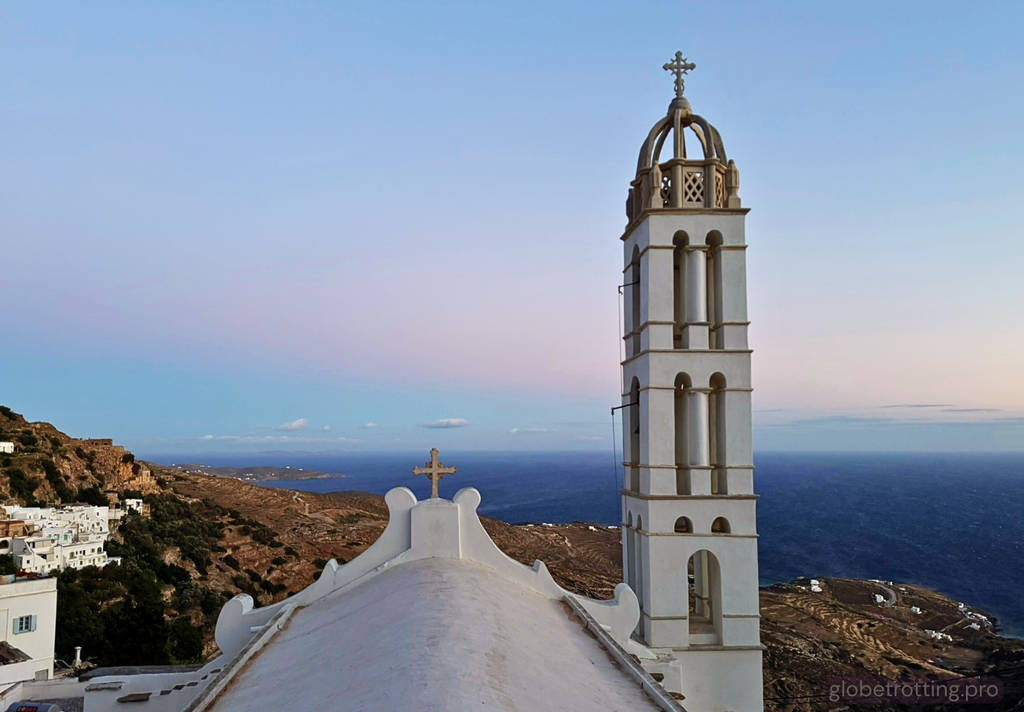
Standing there, barefoot above the church, with the wind whipping around me and the Aegean stretching endlessly in every direction, I experienced one of those rare moments that are almost impossible to describe. It wasn’t excitement. It wasn’t peace. It was something in between. I felt incredibly small against the vastness of the landscape, yet strangely connected to it at the same time. The sky seemed to dissolve from gold into pink and finally into pale purple, while the sea below caught every changing colour. For a few quiet minutes, it felt as though I could almost touch the horizon. This remains my favourite memory of Tinos.


As the sky turned orange, we made our way back to Pyrgos and found a table at To Yiasemi just before the restaurant filled to capacity. Within minutes, members of a women’s association began arriving for an evening of live music, and what had been a quiet village suddenly came to life. At one point the musician played Ήταν Ένα Μικρό Καράβι, a traditional Greek children’s song we had completely forgotten. Jason immediately lit up, asking for it “again” over and over, much to everyone’s amusement. We had a light dinner of mushroom kritharaki and beautifully cooked calamari, and lingered a little longer, enjoying the music and the lively atmosphere, before setting off for the half-hour drive back to the hotel.

Alohari Beach Bar at Rochari Beach
Our final full day on the island took us northwest toward Panormos. The harbour was pleasant enough, with fishing boats gently bobbing in the water and cafés beginning to fill with people enjoying a leisurely morning, but it never quite drew us in. After a short walk, we continued to Rochari Beach, which had been high on my list before the trip.

At first glance, it was exactly the kind of beach I am instinctively drawn to. Fabric canopies stretched between wooden poles, their linen panels dancing in the wind above colourful ottomans and low tables, creating a relaxed, almost bohemian atmosphere. I have always loved that aesthetic. But that same wind, which made the canopies so beautiful, also carried fine sand through the air. Within minutes, it was everywhere, and combined with my general preference for rockier beaches over sandy ones, we decided not to stay long. Sometimes a place is beautiful without being the right place for you. So we packed up and headed inland toward Ysternia instead.

Isternia
Ysternia quickly became my second favourite village on the island. Like so many villages on Tinos, it is built into the hillside, but there was something about its quiet elegance that immediately stood out. We wandered through its narrow marble-paved alleys, passing whitewashed houses, flower-filled courtyards and little corners that seemed to open unexpectedly onto the sea.

Our walk eventually brought us to the Church of Saint Paraskevi. Throughout different periods of my life, I have often found myself unexpectedly crossing paths with churches dedicated to this particular Saint during moments when I was searching for guidance. This time felt different. I smiled to myself, grateful that I had arrived simply as a traveller, with no heavy questions to answer and nowhere else I needed to be.

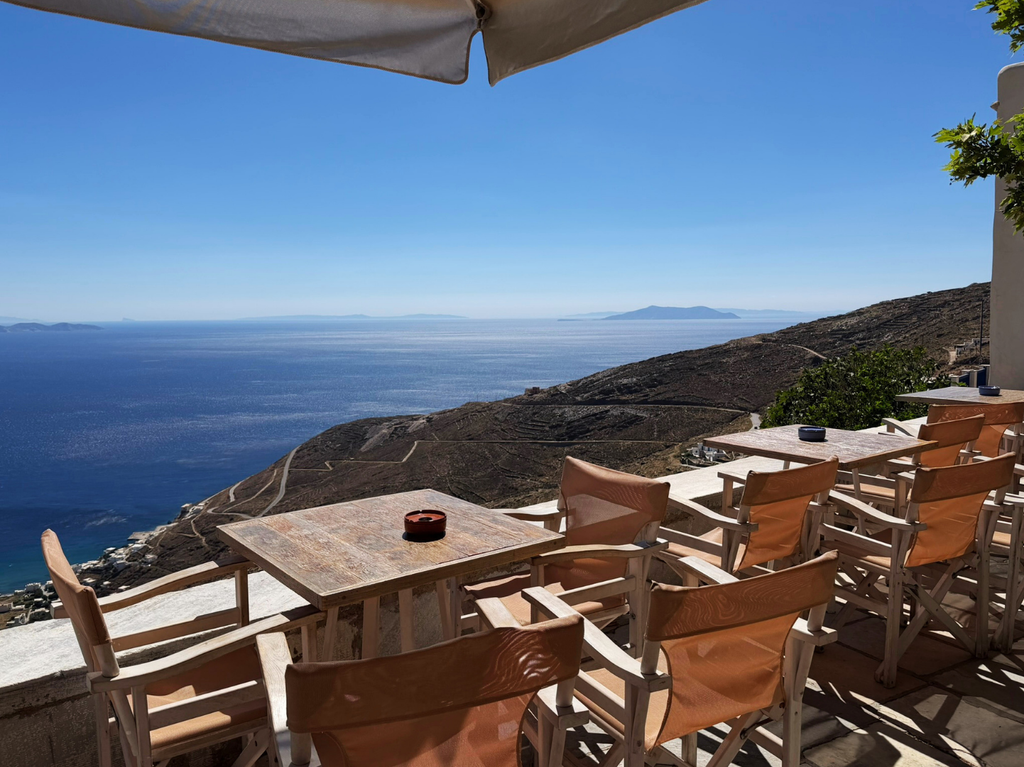
By midday, the June sun had become relentless, so we cut our walk short and looked for somewhere to escape the heat. We could not have chosen a better place than Mayou All Day Bar. As luck would have it, the corner table at the very front had just become available. Sheltered beneath large umbrellas, it overlooked the endless blue of the Aegean, with terraced hills rolling down toward the sea below. We ordered a leisurely brunch of omelettes, smoked salmon on toasted bread, simple grilled cheese toast, freshly squeezed orange juice, and the café’s homemade lemonade, and stayed far longer than we had intended. The view never became ordinary, no matter how long we sat there. Meanwhile, our little one entertained himself playing peekaboo with one of the waitresses before running laps around the trees on the terrace, turning strangers into playmates as toddlers somehow always do.

Volax
Next, we headed to Volax, perhaps the most unusual village on the island. Located in a landscape scattered with enormous rounded granite boulders, it almost felt as though giants had been playing marbles centuries ago. The massive rocks, from which the village takes its name, create an almost lunar landscape unlike anywhere else on Tinos. Traditionally, many of the villagers earned their living weaving baskets, a craft that is still celebrated today through small workshops and displays around the village.


At one of the village entrances, we came across the village’s open-air stone theatre before wandering through its quiet lanes to the small Folk Museum, where everyday household objects offered a glimpse into life on Tinos a century ago. What stayed with me most, however, was not the museum but the village itself. Poems and lyrics from well-known Greek songs appeared everywhere, painted on walls, window shutters, and old wooden doors, turning an ordinary stroll into something unexpectedly poetic. Meanwhile, our little one happily explored every corner he could find, eventually wandering into the studio of a local photographer, where he promptly made friends with the resident dog as though he had been expected all along.

Before leaving, we stopped at Petrino to pick up a few local products to bring home, including honey, herbal teas, and tomato jam. Naturally, we couldn’t pass by a place called Ice Cream of Volax without stopping. The lawyer in me immediately wondered how they had settled on such a wonderfully descriptive trade name. I suspected registering it as a trademark would have been difficult unless they could show it had acquired distinctiveness over time. Then again, in a village of barely fifty residents, perhaps that wasn’t such a high hurdle after all. Inside, one of the walls was painted with the lyrics of an old Greek song about melted ice cream running down your hands, a detail that made me smile.
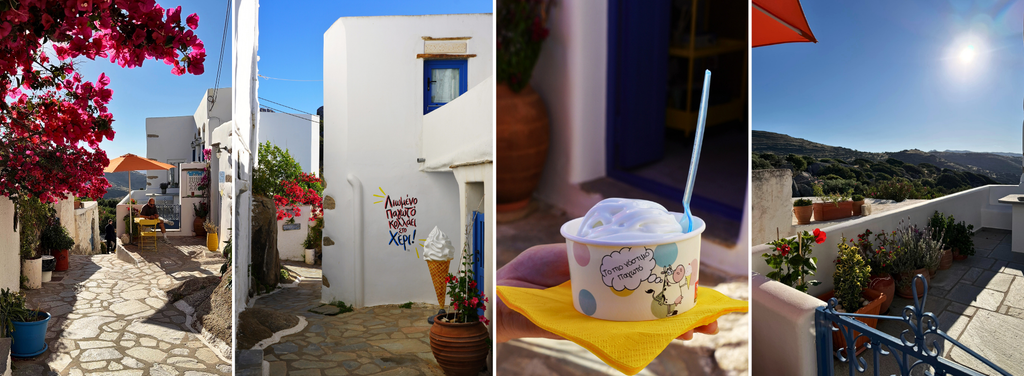
By this point in the trip, we had also noticed a rather amusing pattern. Our toddler’s appetite had almost disappeared, yet he had developed a remarkable talent for walking into bakeries, cafés and restaurants announcing to complete strangers that he was hungry, as though we had been depriving him of food all week. We eventually learned to follow his lead. This time it brought us to Kafe-Nai, a playful nod to the Greek word for ‘coffee’ and ‘yes’. We ordered local cheeses, artichokes, zucchini fritters and fries, convinced that his dramatic announcement would finally be followed by a hearty meal. True to form, he ate a few fries and declared himself finished, leaving the rest to the two people who, apparently, had not been nearly as hungry as he had insisted he was.


Smardakito
Leaving Volax, we drove through the countryside, passing some of Tinos’ iconic pigeon houses before reaching our final stop of the day. Built primarily during the Venetian period, these distinctive stone towers were designed to house pigeons, whose droppings were prized as a natural fertilizer while the birds also provided meat for local families. Their intricate stonework and geometric decorations are a reminder that, on Tinos, even the most practical buildings were crafted with remarkable attention to detail.

Smardakito welcomed us with its beautiful Catholic church and what appeared to be a taverna, Katoi sto Smardakito, spread around the church square and extending toward the old communal washhouse, where villagers once gathered to do their laundry. It was exactly the sort of place where you could imagine spending an entire evening over dinner. Had we not already enjoyed our unexpected meal in Volax, we would almost certainly have ended the day there.
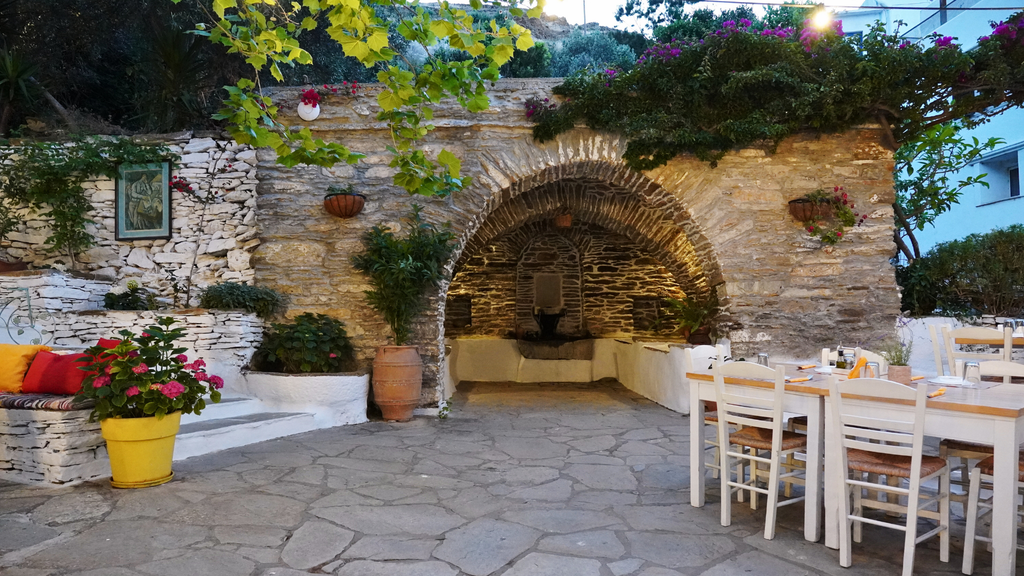
Instead, we wandered through the quiet lanes of the village, following the sound of music drifting through the evening air. It was such a thoughtfully curated playlist that my husband became convinced it had to be coming from a hidden bar and encouraged me to investigate. As I approached the small terrace where the music was playing, a gentleman looked up at me with understandable curiosity and asked if he could help. Slightly embarrassed, I asked whether this was, in fact, a bar. He smiled and replied, “No… it’s a house.” I apologized with a laugh and walked away, only realizing afterwards that I had completely forgotten to tell him how much I had enjoyed his music selection. It remains one of those wonderfully awkward travel moments that still makes us smile whenever we think back on our time in Tinos.

Impromptu Vineyard Tour at Ivy Natural Resort
The following morning, we resisted the temptation to rush. Instead, we enjoyed our last few hours at Ivy Natural the same way we had spent most of our mornings there, with breakfast by our private pool overlooking the hills and the sea. It felt like the right way to say goodbye to Tinos. As we packed our bags and chatted with the receptionist before checking out, our conversation naturally turned to wine. Curious about the small vineyard that stretched across the resort, we asked him about it. He explained that it had been planted only in 2023, so the vines were still too young to have produced their first vintage. Even so, the vineyard already felt like it belonged there. Rather than standing apart from the property, it blended seamlessly into the surrounding landscape, as though it had always been part of the hillside.

Before we left, he kindly offered to walk us through the vineyard and tell us more about it, insisting on taking a few family photos along the way. Like most parents, we have countless pictures of our toddler either pulling funny faces or refusing to look at the camera altogether. Somehow, the moment the receptionist picked him up, he rewarded us with the biggest, most genuine smile of the entire trip.

Costas Tsoclis Museum
Before leaving the island, we made one final stop at the Costas Tsoclis Museum, dedicated to one of Greece’s most celebrated contemporary artists. The museum itself is striking in its simplicity. Its minimalist architecture unfolds across two levels, with an open-air amphitheatre forming the centerpiece of the museum’s design. The entrance immediately catches your attention with a monumental interpretation of Saint George slaying the dragon. Tsoclis, now in his mid-nineties, is considered one of the leading figures of Greece’s first post-war generation of artists, known for gradually introducing three-dimensional elements into his paintings and blurring the boundary between painting and sculpture.
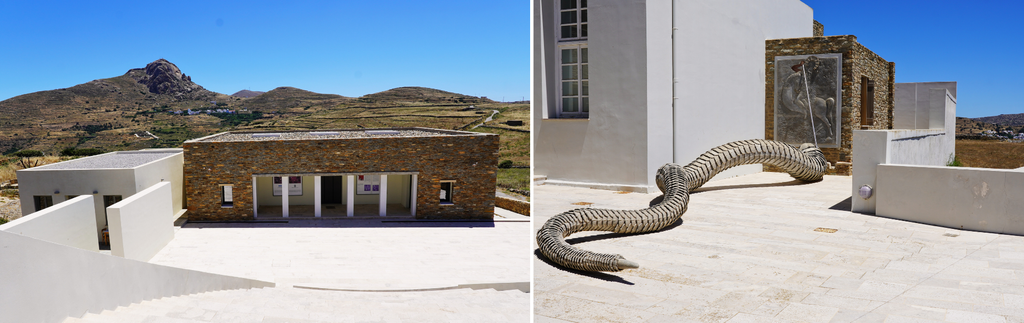
What moved me most, however, was not a particular artistic technique but the way he chose to tell the story of his life. Running through the corridors is a chronology that intertwines his personal memories with the major historical events that shaped Greece during his lifetime. One passage especially stayed with me: “Whenever I think about my childhood, I feel a quiet sadness… I no longer recognize myself in those long-gone moments. Even when I speak about myself, I speak about someone else, someone who simply happened to bear my name.” There was something remarkably honest about those words, reminding me how memory slowly transforms the people we once were into strangers we try to understand.

Among the works on display, I found myself returning to one in particular: two weathered buckets suspended before a painted landscape, one reflecting the brightness of day and the other the darkness of night. It was deceptively simple and yet quietly captivating. Visiting an art museum with a toddler required the usual choreography of taking turns while one of us followed an energetic little explorer determined to inspect every corner. Before entering, we had been asked to keep our voices low because Costas Tsoclis himself was working on the premises. As we were leaving, we unexpectedly crossed paths with him. At ninety-six years old, he was still creating. Somehow, that felt like the perfect final image to take home from Tinos.
Heart of Jesus Chapel near Exomvourgo
Before making our way back to the port, we stopped at the Heart of Jesus Chapel near Exomvourgo. Built in the early twentieth century by the island’s Catholic community, the small chapel sits high on the slopes below the Venetian fortress of Exomvourgo and has become a place of quiet prayer and reflection. Perched above much of the island, it offered one last sweeping view across the terraced hills, whitewashed villages and the endless blue of the Aegean. We wandered quietly around the grounds, taking in the landscape that had become so familiar over the past week. Standing there, with the wind once again reminding us we were on a Cycladic island, it felt as though Tinos was offering us one final invitation to pause before returning to everyday life.

Mikro Karavi Restaurant
Our final meal on the island was at Mikro Karavi, tucked away in what felt like a hidden garden. After days of windswept beaches and open terraces, the shaded courtyard, filled with greenery, offered a completely different atmosphere. We ordered a spinach tart with local cheeses, marinated sardines served over taramasalata with dill oil, and trahanas with sea bass. Like so many meals we had enjoyed throughout the week, the dishes were thoughtful without being complicated, allowing simple, local ingredients to shine. It was a brief lunch, dictated by the ferry schedule, but somehow it captured everything we had come to appreciate about Tinos. Good food, genuine hospitality, and beautiful surroundings, all enjoyed without hurry. It felt like a fitting farewell before boarding the ferry back to the mainland.

As we boarded the ferry back to the Port of Rafina, I felt full in every sense of the word. Full from extraordinary meals, breathtaking landscapes, and quiet moments shared as a family, but also from the slower rhythm of island life. Tinos reminded me that the richest journeys are not always the busiest ones. Sometimes they are simply the ones that leave enough space to notice, to appreciate, and to feel.